



High-Efficiency and Energy-Saving Complete Solution for a Fully Automated Pasta Production Line
If you want to know more story about LOYAL brand, here can help you - https://www.facebook.com/foodmachineloyal
Overview of a High-Efficiency and Energy-Saving Complete Solution for a Fully Automated Pasta Production Line
The Fully Automatic Macaroni Pasta Production Line has become a central direction in modern food-processing system upgrades, driven by the global demand for consistent quality, stable output, and reduction of operational energy consumption. A high-efficiency and energy-saving configuration enables production plants to strengthen capacity expansion while maintaining precise control over processing parameters, ultimately improving product uniformity and overall manufacturing stability.
Development Trend of Fully Automated Pasta Production Lines
Digitalization, continuous processing, and integrated control have reshaped the structure of pasta manufacturing. Modern systems revolve around automated material handling, intelligent extrusion control, and optimized thermal management. Technologies embedded in the Macaroni Pasta Production Line support continuous operation with minimized manual intervention, aligning with the industry’s shift toward predictable performance, reduced downtime, and fully standardized processing environments.
Significance of High Efficiency and Energy Saving in the Food Processing Industry
Energy-efficient manufacturing is an increasingly essential requirement across the food-machinery sector. Reducing heat loss, improving mechanical conversion efficiency, and optimizing airflow in drying systems form the foundation of energy-saving pasta production. When a production line integrates advanced drive systems, automated dosing, and controlled thermal cycles, its overall operational cost decreases significantly. These performance advantages also support cleaner production and sustainable industrial development.
Application Value of Pasta Equipment and Production Lines
The combination of Macaroni Equipment, Vacuum Extruder, and supporting thermal units plays a decisive role in shaping product density, texture, and dimensional accuracy. In a high-efficiency system, the Vacuum Extruder provides stable pressure conditions that refine dough structure and strengthen extrusion consistency, enabling continuous, high-precision output. Integrated process control also enhances reliability, allowing the Fully Automatic Macaroni Pasta Production Line to maintain uniform performance under long-term industrial production cycles.
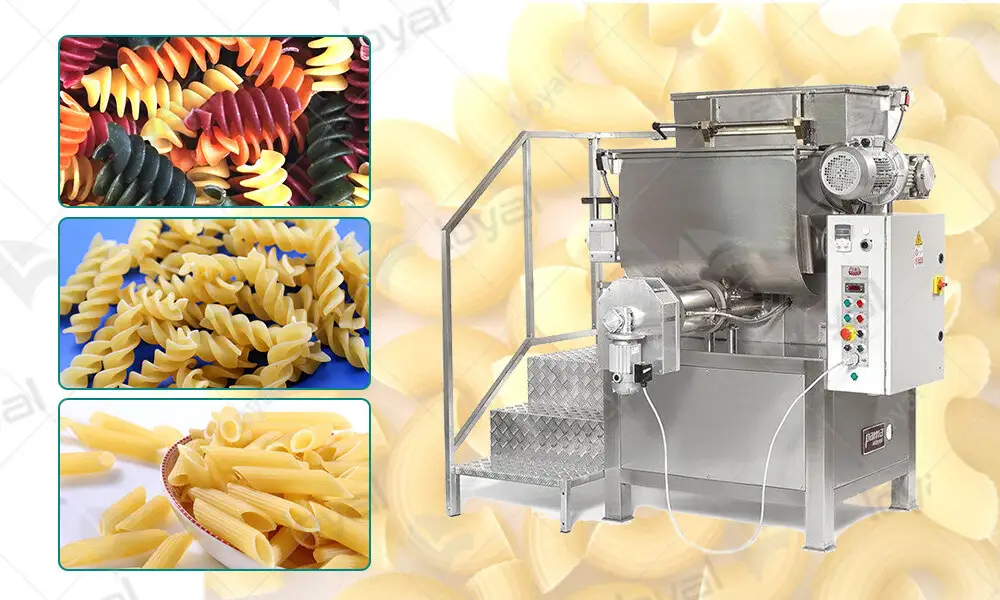
Core Structure and Process Flow of a Fully Automated Production Line
A Fully Automatic Macaroni Pasta Production Line operates through a coordinated set of mechanical and thermal processes designed to ensure stable output, consistent product dimensions, and controlled energy consumption. Its workflow integrates raw-material management, extrusion, drying, cooling, and packaging into a continuous system that supports long-duration industrial production without interruption.
Raw Material Proportioning, Mixing, and Pretreatment
Efficient processing begins with an automated proportioning system that handles semolina or blended flour with controlled precision. The mixing unit maintains uniform hydration and dough structure, allowing consistent feed characteristics during extrusion. Pretreatment modules stabilize moisture distribution, preparing material for high-performance extrusion within the Macaroni Pasta Production Line. These steps reduce variation in dough properties and help maintain steady forming conditions.
Key Role of the Vacuum Extruder in Pasta Forming
The Vacuum Extruder forms the core of the shaping process. By operating under reduced-pressure conditions, it improves dough compaction, enhances protein network formation, and minimizes trapped air. These effects directly influence extrusion uniformity, resulting in smooth, dense macaroni shapes with reliable structural integrity. In a fully automated system, the extruder’s drive control, temperature management, and screw-configuration monitoring ensure stable output throughout extended production cycles. The integration of advanced extrusion control allows Macaroni Equipment to maintain consistency within tight industrial tolerances.
Coordinated Operation of Drying, Cooling, and Automatic Packaging
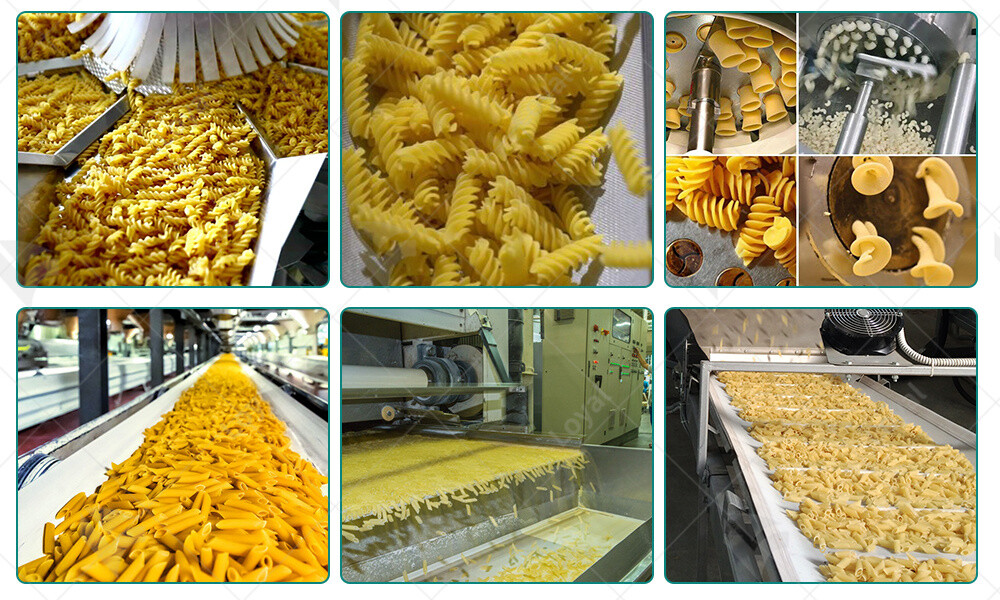
After extrusion and cutting, products enter a multi-stage drying system that regulates airflow, temperature, and humidity to achieve uniform moisture reduction. Controlled thermal cycles reduce energy waste and support structural stability. Cooling sections stabilize product temperature before final handling. Automated packaging lines then perform weighing, sealing, and labeling with minimal manual involvement, closing the final step of the Fully Automatic Macaroni Pasta Production Line process flow.
Application of Energy-Saving Technologies in Pasta Production Lines
Energy-saving technologies have become a decisive factor in the modernization of pasta-manufacturing systems. Within a Fully Automatic Macaroni Pasta Production Line, efficiency improvements are achieved through optimized mechanical performance, controlled thermal operation, and smart process coordination. These technologies work together to reduce operational load, stabilize processing conditions, and enhance long-term productivity.
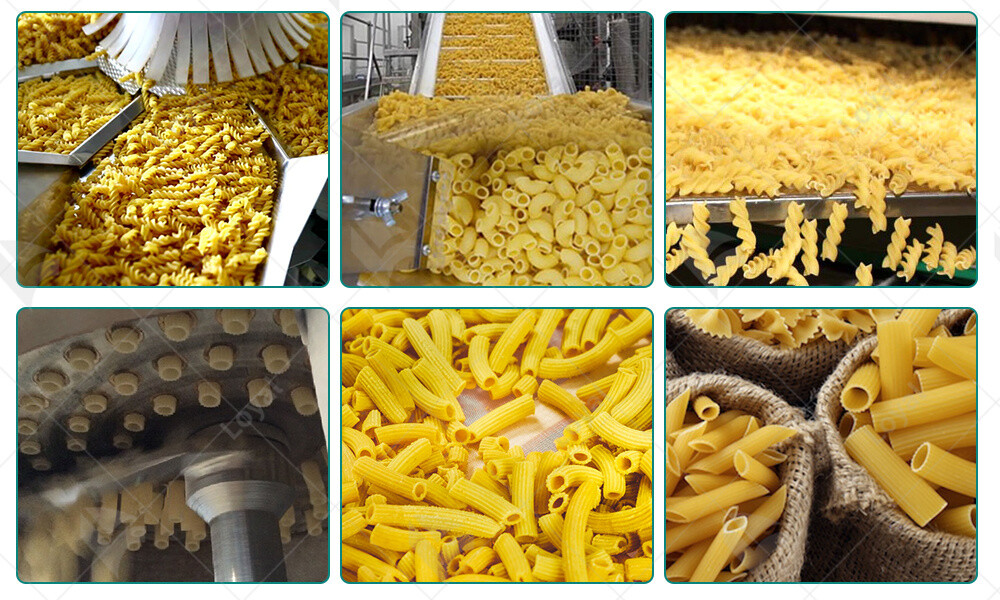
Energy-Saving Extrusion Technology of the Vacuum Extruder
The Vacuum Extruder incorporates several engineering features designed to reduce energy consumption while maintaining high output stability. Advanced screw geometries, optimized compression ratios, and reduced-pressure forming help improve mechanical efficiency. By minimizing unnecessary torque output, the system requires less power to maintain consistent material flow. Under vacuum conditions, air removal enhances compactness and reduces internal resistance during extrusion, contributing to smoother shaping and lower energy demand. These characteristics enable the extruder to maintain high forming accuracy with reduced operational losses, supporting long-duration industrial production.
Integrated Energy Optimization in Pasta Production Lines
Energy-saving strategies extend beyond the extruder to the entire Macaroni Pasta Production Line. Automated airflow control in drying units, proportional heating management, and stabilized moisture cycles help reduce thermal waste. Precision temperature regulation ensures that heat is delivered evenly and only when required, preventing excessive consumption. In addition, coordinated system control enhances the performance of interconnected Macaroni Equipment, ensuring that each module operates at optimal load levels. Together, these elements create a production environment that supports high efficiency, consistent output quality, and long-term energy reduction.
Complete Equipment Configuration and Selection Recommendations
A modern Fully Automatic Macaroni Pasta Production Line requires properly configured equipment to ensure stable shaping performance, consistent moisture control, and efficient thermal processing. The selection of each component influences production capacity, product uniformity, and long-term operational efficiency. Therefore, equipment configuration must be aligned with technical requirements, expected throughput, and energy-saving objectives.
The integration of Macaroni Equipment begins with accurate ingredient dosing and controlled dough preparation. These stages determine hydration uniformity, an essential factor affecting extrusion quality. Systems with adjustable feeding mechanisms and stable mixing functions support consistent dough density before extrusion. Advanced lines also include monitoring sensors that maintain precise operating conditions, contributing to controlled mechanical and thermal behavior throughout the process.
The Vacuum Extruder is the defining component in macaroni production configuration. When selecting an extruder, priority should be given to vacuum capacity, screw design, torque stability, and extrusion chamber geometry. Adequate vacuum pressure improves dough compactness, ensuring reduced internal air and enhanced structural consistency. This allows the Macaroni Pasta Production Line to produce uniform shapes with predictable drying characteristics. The extruder’s energy efficiency depends on mechanical design that minimizes friction losses and supports stable processing at controlled motor loads.
Downstream equipment—including pre-drying, main drying, cooling, and packaging units—must be selected based on airflow distribution, thermal zoning precision, and material handling stability. Drying systems with segmented temperature control and optimized heat circulation reduce thermal waste and maintain structural integrity during moisture removal. Cooling units should maintain balanced airflow to avoid deformation before packaging, while automated packaging modules ensure continuous output without manual intervention.
The following table summarizes essential configuration elements for efficient production line setup:
Key Equipment Configuration Parameters
| Equipment Category | Recommended Selection Focus |
| Raw Material Dosing | Precision feeding and stable ratio control |
| Mixing System | Uniform hydration and consistent dough texture |
| Vacuum Extruder | Vacuum stability, screw efficiency, and chamber precision |
| Pre-Drying Unit | Controlled airflow and moderate moisture reduction |
| Main Dryer | Multi-zone temperature control and optimized heat utilization |
| Cooling Module | Even airflow distribution for dimensional stability |
| Packaging Unit | Continuous operation and minimal handling |
Through balanced configuration across these components, the Fully Automatic Macaroni Pasta Production Line achieves consistent shaping quality, stable thermal performance, and efficient long-term operation. Proper equipment selection ensures the system operates with strengthened reliability and optimized energy usage.
Operating Cost Control and Maintenance Strategies
Efficient management of operational costs is essential for maintaining the long-term performance of a Fully Automatic Macaroni Pasta Production Line. Cost optimization involves controlling energy consumption, stabilizing equipment operation, and reducing unplanned downtime. Through coordinated production scheduling, balanced thermal management, and preventive maintenance, manufacturers can sustain consistent output while minimizing resource waste.
Energy consumption represents a significant portion of operating costs. By optimizing each step of the Macaroni Pasta Production Line, facilities can reduce unnecessary power usage. Precise dosing and controlled dough hydration prevent overmixing, while balanced moisture content reduces the energy required during extrusion and drying. Systems equipped with adjustable airflow and modular heat zoning maintain stable drying conditions, preventing energy loss and supporting predictable moisture removal. The integration of Macaroni Equipment with intelligent monitoring also allows automated parameter adjustments, ensuring that each process stage operates only at required load levels.
Maintenance of core equipment, particularly the Vacuum Extruder, is fundamental for long-term operational stability. Consistent inspection of vacuum seals, screw mechanisms, and extrusion chambers prevents mechanical inefficiencies that lead to increased power demand. Lubrication schedules, component alignment, and temperature monitoring contribute to reduced wear and improved processing uniformity. When maintained correctly, the Vacuum Extruder operates with lower mechanical resistance, supporting energy-efficient extrusion and reducing thermal fluctuations in downstream stages.
Drying systems also require regular maintenance to preserve airflow uniformity and temperature stability. Clean airflow channels, stable fan operation, and accurate humidity sensors ensure that the Macaroni Pasta Production Line maintains consistent drying behavior. This prevents over-drying or uneven moisture reduction, both of which can elevate energy costs and reduce product consistency. Cooling units and packaging modules must also maintain synchronized operation to avoid unnecessary system cycling or bottlenecks that increase energy use.
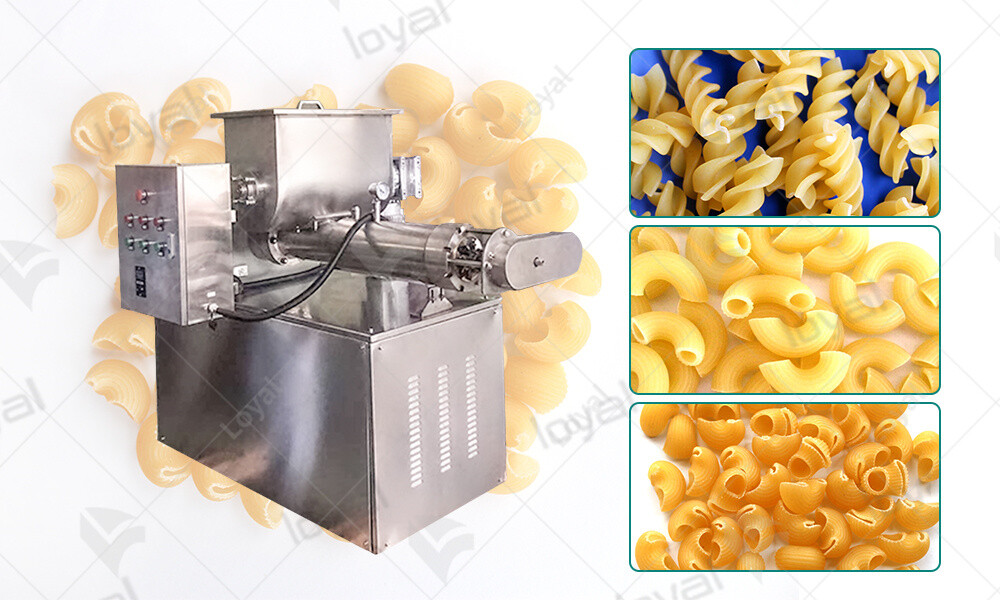
The table below summarizes key maintenance and cost-control strategies:
Cost Control and Maintenance Focus Areas
| Area | Key Strategy |
| Energy Management | Optimized heat distribution and controlled airflow |
| Vacuum Extruder Maintenance | Seal inspection, screw stability, reduced mechanical load |
| Drying System Efficiency | Clean airflow channels and precise humidity control |
| Process Coordination | Stable synchronization among production stages |
| Preventive Maintenance | Scheduled checks to reduce downtime and component wear |
By applying these strategies, the Fully Automatic Macaroni Pasta Production Line maintains reduced operating costs, stable mechanical performance, and prolonged equipment lifespan, supporting sustainable and efficient macaroni production.
Automation Coordination and Production Stability
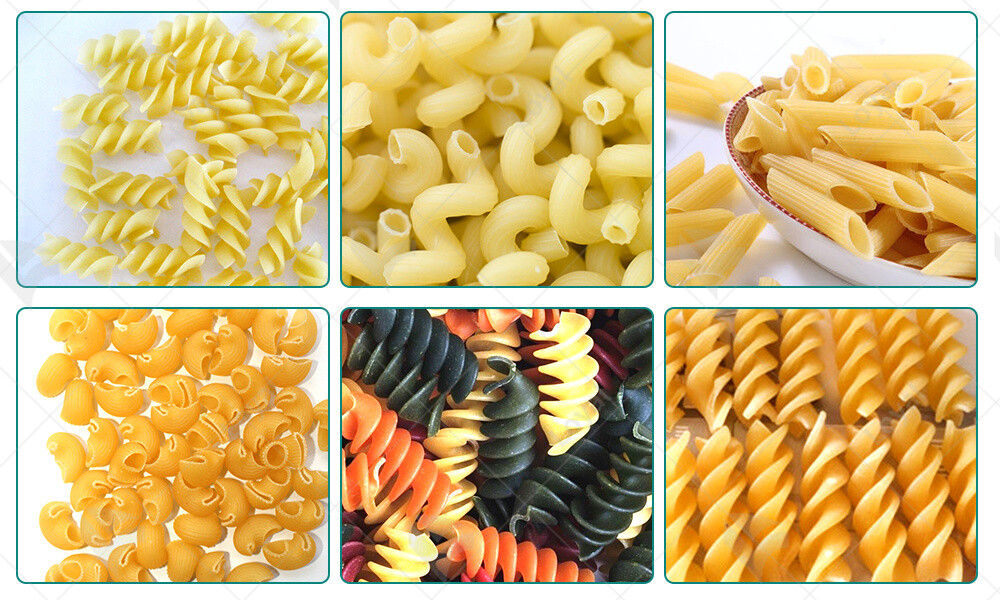
Stable operation of a Fully Automatic Macaroni Pasta Production Line depends on precise coordination among all processing stages. Integrated automation ensures that material flow, mechanical movement, and thermal management remain synchronized, preventing fluctuations that could disrupt production efficiency. When each stage communicates through unified control logic, the system maintains continuous processing with minimal manual intervention.
The feeding and mixing sections regulate ingredient proportions and moisture levels before dough enters the Vacuum Extruder. Consistent vacuum conditions support structural uniformity and extrusion stability. When vacuum intensity, screw rotation, and temperature remain balanced, the extruded macaroni maintains steady density and form. Downstream transport modules are calibrated to match extrusion output, ensuring uninterrupted transfer without compression or deformation.
Drying sections play a central role in overall system stability. Automated temperature zoning and controlled airflow prevent abrupt thermal changes. The modular configuration of Macaroni Equipment allows fine adjustments to maintain gradual moisture reduction. When drying profiles remain steady, the pasta retains uniform internal structure, supporting predictable cooling and packaging performance. Automated sensors continuously adjust heat distribution, airflow rate, and humidity balance to maintain consistent drying curves.
Packaging lines finalize production stability by regulating flow speed and sealing accuracy. When synchronized with upstream output, the Macaroni Pasta Production Line avoids bottlenecks and unnecessary system cycling. Coordinated automation reduces wear, energy consumption, and system vibration, contributing to long-term operational reliability.
Automation Coordination Elements
| System Area | Coordination Focus |
| Feeding & Mixing | Ingredient stability and moisture control |
| Vacuum Extruder | Vacuum balance and extrusion uniformity |
| Drying Modules | Thermal stability and gradual moisture reduction |
| Transport System | Smooth transfer between stages |
| Packaging Line | Flow synchronization and sealing stability |
Through coordinated automation, the Fully Automatic Macaroni Pasta Production Line maintains stable performance, reduced operational variability, and reliable product consistency.
Conclusion and Future Integration Outlook
A fully optimized Fully Automatic Macaroni Pasta Production Line strengthens the entire structure of modern pasta manufacturing by combining efficiency, quality stability, and long-term sustainability. Through the coordinated operation of mixing, extrusion, drying, cooling, and packaging modules, production becomes predictable and uniform, supporting higher throughput with fewer fluctuations. When key technologies such as the Vacuum Extruder operate under controlled mechanical and thermal parameters, the resulting macaroni structure maintains consistent density and shape, reinforcing overall product reliability.
Energy-saving and automation-driven strategies further improve operating stability. Integrated monitoring systems adjust airflow, temperature, and vacuum pressure in real time, allowing each component of the Macaroni Pasta Production Line to function within ideal productivity zones. Reduced mechanical stress, balanced load distribution, and minimized idle cycling contribute to longer equipment lifespan and predictable maintenance intervals. Together, these elements increase the return on investment for manufacturers while lowering production risks.
Future technological development will continue to expand the capability of Macaroni Equipment. Advancements in adaptive control algorithms, heat-recovery systems, and predictive maintenance tools will support even more efficient processing. Unified digital interfaces will allow operators to supervise complex workflows with greater precision, enhancing energy performance and production accuracy. As global food manufacturing trends move toward automation and sustainability, a fully integrated macaroni production system will remain an essential solution for stable, high-quality output.
Reference
The following are five authoritative foreign literature websites in the field of Industrial food machinery:
1. Food Engineering Magazine
Website: https://www.foodengineeringmag.com/
2.Food Processing Magazine
Website: https://www.foodprocessing.com/
3.Journal of Food Engineering
Website:https://www.journals.elsevier.com/journal-of-food-engineering
4. Food Manufacturing Magazine
Website:https://www.foodmanufacturing.com/
5. International Journal of Food Science & Technology
Website:https://onlinelibrary.wiley.com/