



Understanding TheNutritional riceproduction line:The Ultimate Guide ToNutritional riceproduction line
If you want to know more story about LOYAL brand, here can help you - https://www.facebook.com/foodmachineloyal
Nutritional rice differs from traditional rice. It typically achieves optimized appearance, taste, and nutritional content through extrusion reshaping processes, nutritional fortification technology, and precise formula control. Therefore, manufacturing high-quality nutritional rice has a high technological threshold, requiring fully automated nutritional rice production equipment with a well-structured, stable, and highly automated process. Currently, next-generation nutritional rice production technology is evolving from traditional manual mixing and inefficient drying towards intelligent control, high efficiency, energy saving, and continuous, stable mass production. All of this relies on advanced nutritional rice production line equipment.
From a national policy perspective, the "14th Five-Year Plan for Food Industry Development" clearly states the need to promote the upgrading of the food manufacturing industry towards intelligent and green development, and to increase the added value of deep-processed grain products. Nutritional rice equipment and production lines perfectly align with this policy direction: high automation, low energy consumption, strong raw material adaptability, and high nutrient retention rate, significantly enhancing the overall competitiveness of reprocessed grain products.
As part of advanced food equipment, fully automated nutritional rice equipment is not only key to improving production capacity and quality but also an important tool for enterprises to achieve energy conservation and emission reduction, align with market trends, and enhance brand value. The following chapters will provide an in-depth analysis of its structure, function, process flow, and future development direction.
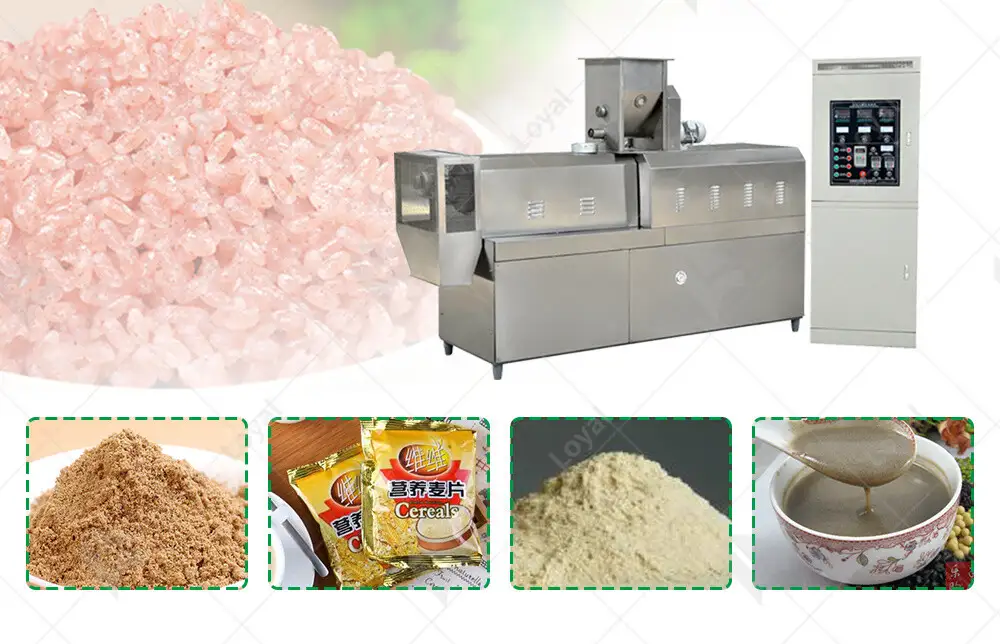
Core Components and Functional Features of Fully Automatic Nutritional Rice Equipment
| Category | Description | |
| Main Components | Modern nutritional rice equipment typically consists of a dosing system, twin-screw extruder, drying machine, cooling unit, lifting & conveying system, shaping unit, and packagingsystem. | |
| High Automation | From raw material dosing to final product packaging, the entire process can run automatically, significantly improving production efficiency. | |
| Precise Temperature & Pressure Control | Ensures better nutrient retention and enhances the texture and molding quality of nutritional rice. | |
| Energy-Saving Design | Optimized structure enables lower steam consumption and reduced overall energy usage. | |
| High Hygiene & Safety Standards | All equipment is made of food-grade stainless steel and meets HACCP and GMP food safety requirements. | |
| Expert Opinion |
|
Comprehensive Analysis of the Production Process of Nutritional Rice
| Process Step | Description |
| Raw Material Pre-Processing | Corn flour, rice flour, wheat flour, and nutritional fortifiers are blended in precise proportions to achieve uniform powder mixing. |
| Extrusion Cooking & Forming | The core stage uses a twin-screw extruder with High-Temperature Short-Time (HTST) treatment to ensure rapid cooking, shaping, and nutrient fortification. |
| Molding & Cutting | Various grain shapes such as long-grain, round-grain, and short-grain nutritional rice can be produced based on mold specifications. |
| Drying Process | A multi-layer circulating hot-air dryer stabilizes the moisture content of nutritional rice at approximately 12%, ensuring excellent storage stability. |
| Cooling & Shaping | This stage prevents deformation and moisture rebound, improving the final packaging quality. |
| Final Packaging | High-precision automatic packaging machines perform weighing, filling, and sealing in one integrated process. |
Industry experts often emphasize: “The core of modern nutritional rice is not the raw materials, but the management of the process curve.”
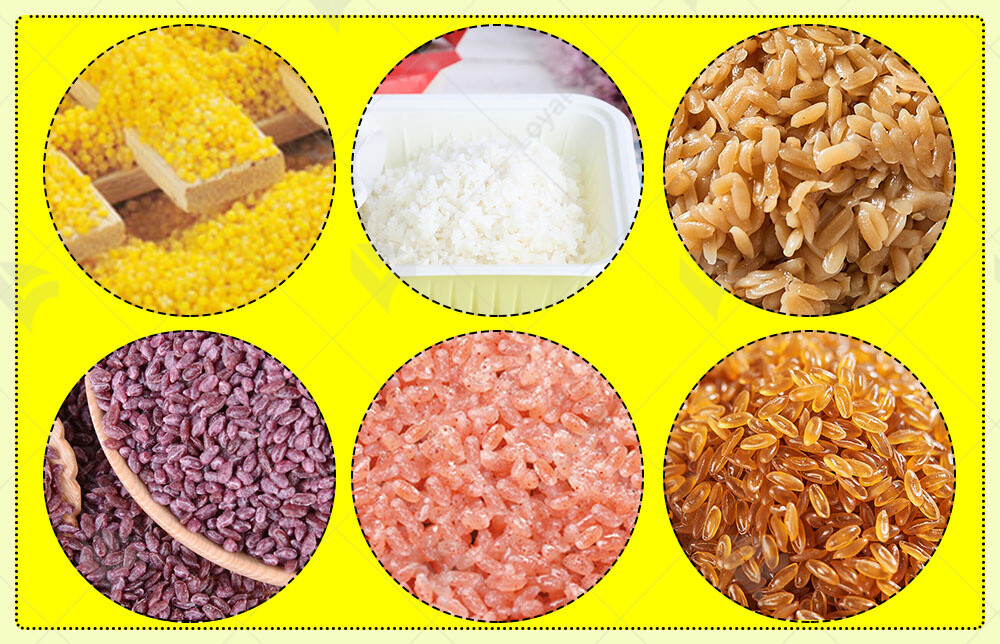
Application of high-efficiency and energy-saving technologies in nutritional rice equipment and production lines
As the food processing industry fully strides toward green manufacturing, energy efficiency has become a crucial indicator for measuring the advancement of nutrient rice production equipment. Modern nutrient rice production lines integrate a series of energy-saving technologies across multiple processing stages, including intelligent temperature control systems, low-energy extrusion technology, cyclic heat exchange devices, and high-efficiency drying systems, aiming to reduce energy consumption, improve production capacity, and minimize emissions. The application of energy-saving technologies not only complies with industry standards but also serves as a key driver for enterprises to enhance their competitiveness.
Firstly, in the extrusion cooking stage, energy-saving twin-screw extruders are the core of technological upgrading. Adopting variable-frequency power systems, precise heating zone control, and closed-loop thermal energy recycling technology, they can reduce heating losses and significantly improve energy efficiency. According to an energy efficiency evaluation report released by the China National Food Equipment Engineering Research Institute: "After adopting the new energy-saving extrusion system, the energy consumption per unit product can be reduced by 18%—25%, while product stability is significantly improved." This data fully demonstrates the importance of energy-saving extrusion technology in reducing production costs. Meanwhile, the extrusion system can dynamically adjust energy consumption by analyzing load changes through intelligent PLC, avoiding ineffective power output and aligning with the modern food machinery trend of "on-demand energy supply."
Secondly, as the most energy-intensive link, the drying system is a key focus for the application of energy-saving technologies. High-end nutrient rice equipment generally adopts technologies such as fluidized bed multi-stage drying, low-temperature high-efficiency hot air circulation, and waste heat recovery systems. Through precise control of humidity, air velocity, and temperature, energy utilization efficiency can be increased by over 40% while ensuring drying uniformity. Dr. Robert Mason, an expert from the International Food Machinery Engineering Association (IFMEA), once emphasized: "Reducing energy consumption in the drying stage is a critical breakthrough for food production lines to move toward green factories." This assertion holds high authority in the industry.
In addition, intelligent systems provide important support for the in-depth application of energy-saving technologies. Modern nutrient rice production lines are generally equipped with intelligent visual control panels, energy consumption monitoring systems, and data tracking functions. By real-time monitoring key indicators such as electricity consumption, heat consumption, and steam usage, the system can automatically optimize operational modes. For example, it automatically enters energy-saving mode during idle or low-load operation and optimizes the energy supply structure during high-load operation, thereby achieving dynamic balance of overall energy consumption.
In summary, the widespread application of high-efficiency energy-saving technologies has not only significantly improved the production efficiency of modern nutrient rice equipment but also enabled enterprises to gain obvious advantages in energy consumption cost control, compliance with environmental requirements, and industry competition.
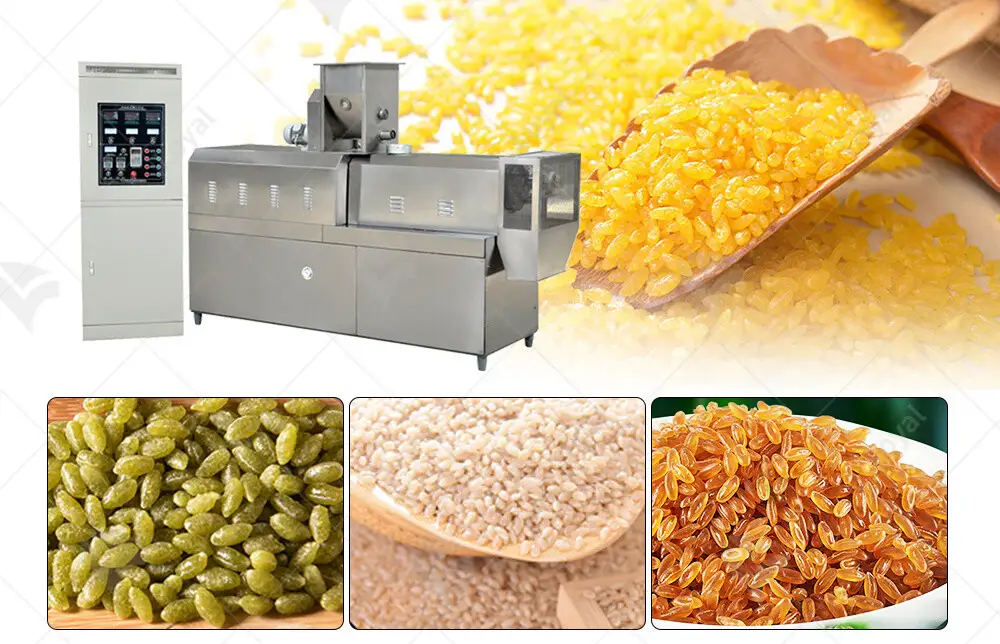
Quality and safety assurance measures for nutritional rice equipment and production lines
To ensure food quality and safety, the equipment must possess the following safeguards:
● Material Safety
Made of 304/316 stainless steel, corrosion-resistant and easy to clean.
● Structural Safety
Key components are equipped with overload protection systems, temperature alarms, and electrical control locks.
● Process Safety
Ensuring high-temperature sterilization and low-oxygen processing to reduce microbial risks.
● Traceable Production Data
The PLC system automatically generates production records, ensuring a traceable food safety process.
Dr. Chen, an expert, stated: "The safety of food machinery is never a single indicator, but rather a comprehensive system encompassing materials, processes, safety protection, and data management."
Application Scenarios and Industry Value of Fully Automated Nutritional Rice Production Line
Fully automated fortified rice production lines are suitable for:
Fortified rice manufacturers
Grain and oil processing plants
Functional food research and development institutions
Emergency food and military ration manufacturers
Social and livelihood food processing projects
Industry value is reflected in:
Enhancing product competitiveness
Meeting diverse consumer health needs
Reducing enterprise energy consumption and labor costs
Improving the level of automation and intelligence in the food industry
According to Professor Liu, a food engineering expert, "Fortified rice is a key product for future staple food structure innovation, and its popularity will be directly related to the level of equipment technology."
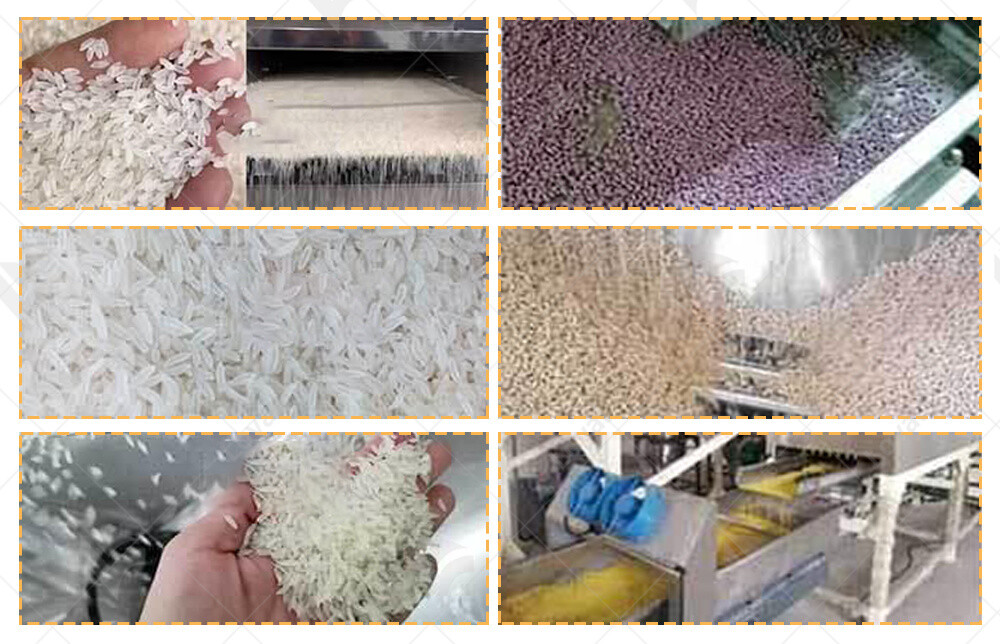
Future Trends: Intelligentization and Green Development Drive Upgrades in Nutritional Rice Equipment
Green energy conservation will be a key direction for upgrading production lines. As enterprises increasingly demand energy conservation and emission reduction, future nutritional rice equipment will see continuous breakthroughs in heat recovery, low-carbon emissions, and low-temperature drying technologies. For example, more advanced multi-stage heat recovery systems, efficient air circulation technology, and energy-saving extrusion chamber structures will further reduce unit product energy consumption by 30%–40%. Simultaneously, solar-assisted power supply, efficient steam utilization, and low-loss motor technology will gradually become widespread in the industry, achieving "green factory" standards. Furthermore, precise nutrition is a crucial component of the future development of nutritional rice. With the continuous increase in consumer demand for functional foods, nutritional rice production lines will be able to achieve precise micronutrient delivery through intelligent ingredient mixing and online detection systems. Future production lines will possess functions such as real-time monitoring of vitamin retention rates, automatic ratio correction, and dynamic compensation for nutrient loss, realizing a "customized nutritional staple food" production model.
Reference
The following are five authoritative foreign literature websites in the field of Industrial food machinery:
1. Food Engineering Magazine
Website: https://www.foodengineeringmag.com/
2.Food Processing Magazine
Website: https://www.foodprocessing.com/
3.Journal of Food Engineering
Website:https://www.journals.elsevier.com/journal-of-food-engineering
4. Food Manufacturing Magazine
Website:https://www.foodmanufacturing.com/
5. International Journal of Food Science & Technology
Website:https://onlinelibrary.wiley.com/