



Integrated Solution for Fully Automatic Biscuit Production Line: High Efficiency and Energy Saving
If you want to know more story about LOYAL brand, here can help you - https://www.facebook.com/foodmachineloyal
The global biscuit industry is in the midst of a steady transformation. Market demands for variety, higher quality, food safety compliance, and sustainability have combined to push manufacturers toward more automated, tightly integrated production systems. The biscuit production line—when designed and implemented as a fully automatic, energy-conscious system—can deliver significant benefits: consistent product quality, higher throughput, lower labor dependence, and reduced energy consumption. This article provides a comprehensive, practical guide to integrated solutions for modern biscuit manufacturing, covering core components, operational flow, technical innovations, energy-saving measures, sizing strategies for different plant scales, and practical selection criteria for buyers.

Why Integration and Full Automation Matter Now
Two broad trends are driving investment in integrated biscuit lines. First, consumers demand more product variety—different textures, fillings, shapes, and nutritional profiles—which requires flexible production equipment. Second, operating costs (labor, energy, compliance) are growing, squeezing margins and making efficiency improvements essential.
A fully integrated and automated line transforms discrete machines into a coordinated system. Instead of separate islands of equipment that must be manually balanced, a modern biscuit production line runs dough feeding, forming, baking, cooling, and packaging in a continuous, data-driven sequence. This reduces stoppages, improves throughput predictability, and allows managers to monitor performance at line level rather than by individual machine.
Integration also brings non-production benefits: improved traceability, easier regulatory compliance, safer workplaces (less manual handling of hot or moving parts), and the ability to capture process data for continuous improvement.
Core Components and the Production Flow
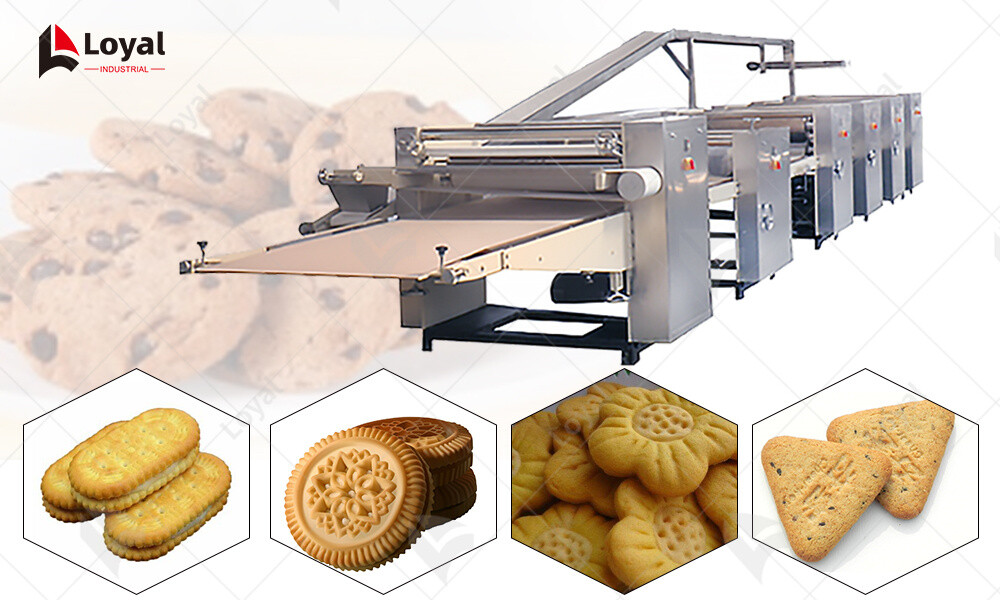
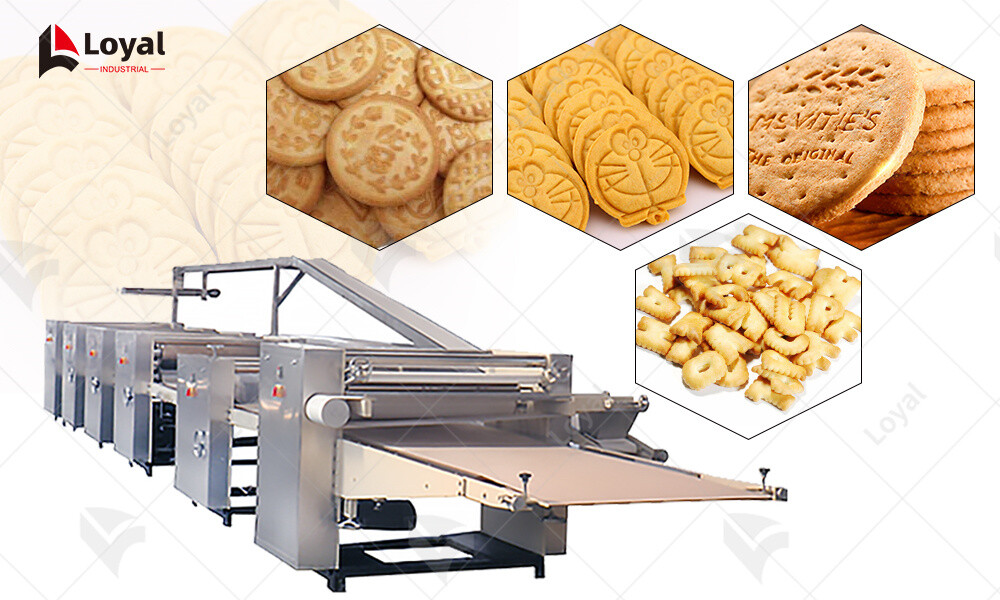
A typical fully automatic biscuit production line consists of the following major blocks. Each block can be configured differently depending on the product mix and output target.
Ingredient Handling and Dosing – Weighing systems, silos, and feeders for flour, sugar, fats, and minor ingredients. Precise dosing is fundamental to repeatable dough quality.
Mixing and Pre-treatment – Batch or continuous mixers with temperature control and automated ingredient addition. Pre-treatment may include sheeting, lamination, or resting.
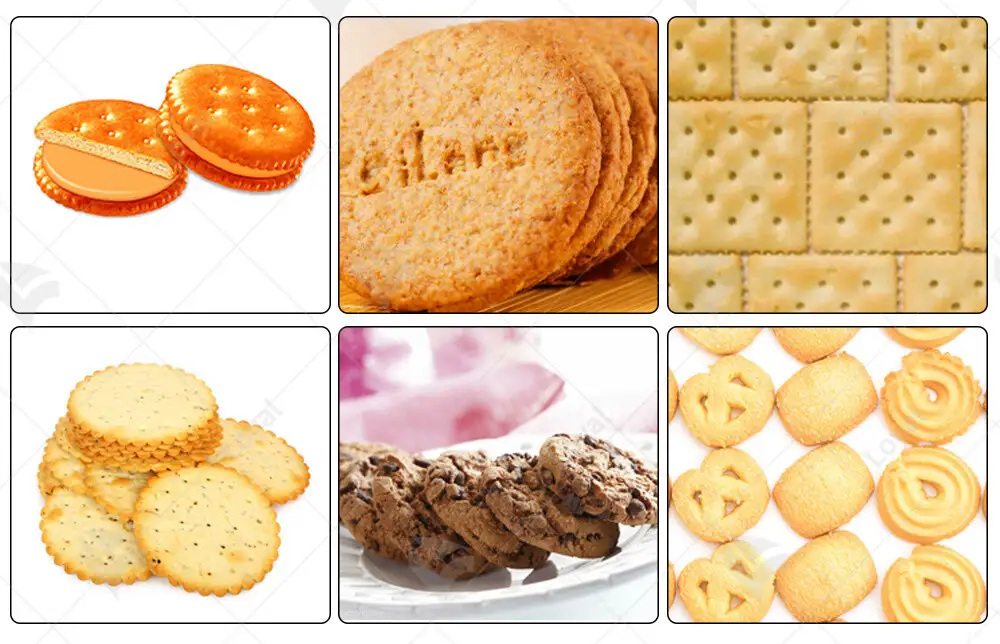
Forming – Rotary molders, sheet-and-cut systems, wire-cut extruders, depositor heads for sandwich biscuits or filled cookies. Forming dictates shape, weight, and surface texture.
Baking – Tunnel ovens with multiple heating zones, adjustable belt speed, and airflow control. Baking profile controls color, moisture, and texture.
Cooling – Conveyors and controlled-air cooling tunnels to stabilize biscuits and prepare them for handling and packaging.
Inspection and Metal Detection – Inline vision systems and metal detectors to ensure product safety and quality.
Packaging – Horizontal flow wrappers, cartoners, or vertical packaging machines integrated with weighing, counting, and labeling systems.
Control and Data Systems – PLC, SCADA, MES (optional) and operator HMIs to coordinate all stages, capture data, and enable remote monitoring.
Dough Mixing: the foundational stage
Mixing determines the basic physical properties of the biscuit—texture, oil distribution, and hydration. Precision dosing, temperature control, and mixing profile are critical. Modern plants may use continuous mixers for high-volume operations; smaller plants might prefer batch mixers with automated recipe control.
Forming and Shaping
Forming achieves final product dimensions and appearance. Choosing the right forming technology depends on biscuit type:
Rotary molding for hard, decorative biscuits.
Sheet-and-cut for softer, layered products.
Wire-cut for high-inclusion doughs (chips, nuts).
Depositing for sandwich and filled items.
Baking, Cooling, and Packaging
Baking usually consumes the most energy; careful oven zoning and airflow control ensure consistent results. A reliable cooling section reduces breakage and prepares product for automated packaging lines, which must match the upstream production speed to avoid bottlenecks.
Automation, Control and Quality Assurance
A hallmark of modern integrated lines is centralized control. PLCs manage machinery, while SCADA systems provide operator dashboards and data logging. For factories aiming at tighter traceability and process optimization, a Manufacturing Execution System (MES) can tie production data to batch records, quality checks, and traceability logs.
Key control capabilities include:
Recipe management – automated recall and execution of mixing and oven parameters.
Real-time quality checks – sensors and vision systems to detect size, color, presence of inclusions, or surface defects.
Line balancing – automated speed synchronization between forming, baking, and packaging.
Predictive maintenance – equipment condition data triggers maintenance recommendations before failures occur.
These capabilities reduce human error and make quality outcomes repeatable across shifts and production runs.
Energy Efficiency Measures and Their Practical Effects
Energy efficiency is a dual objective—lower costs and reduced environmental impact. Ovens, motors, and compressed air are common energy sinks in biscuit manufacturing. Below are practical measures and the rough advantages they deliver.
Energy Measures and Typical Benefits
| Measure | Where Applied | Practical Result |
| Oven insulation & heat recovery | Tunnel ovens | Lower fuel consumption, reduced exhaust temperature |
| Variable-frequency drives (VFDs) | Motors, conveyors, blowers | Reduced electrical consumption under partial load |
| Automated airflow zoning | Oven & cooling systems | More uniform baking, less overbaking |
| Waste heat reuse | Preheating air or ingredients | Reduced overall energy input |
| LED lighting & efficient drives | Plant infrastructure | Incremental energy savings |
Heat recovery systems can reclaim exhaust energy and use it to preheat combustion air or for auxiliary heating (e.g., ingredient warming). Variable-frequency drives allow motors to match power to demand instead of running at full speed continuously. Automated control of oven zones ensures energy is not wasted heating zones that are not needed for the current product profile.
Energy Comparison Table (Indicative)
| Component | Legacy System | Modern Energy-Saving System | Typical Improvement |
| Oven | Single-zone, low insulation | Multi-zone, insulated, heat recovery | 15–30% fuel saving |
| Motors | Fixed-speed | VFD-controlled | 10–25% electricity saving |
| Airflow | Manual valves | Automated zoning | More uniform product, less rework |

Maintaining Product Quality: Inspection and Traceability
Automated inspection systems—vision-based color and shape detection, weight control, and metal detection—should be integrated as part of the biscuit production line rather than as add-ons. In-line inspection helps identify deviations quickly and trigger corrective action, reducing waste and ensuring consistent product delivery.
Traceability—capturing batch numbers, ingredient lots, oven profiles, and packaging runs—protects brand integrity and simplifies recall operations if a quality issue ever arises.
Practical Line Configurations for Different Scales
Not every manufacturer needs the same scale or the same degree of automation. Below are practical recommendations for three typical plant sizes.
Small Workshops (pilot to <1 ton/day)
Focus on high-impact automation: mixers with recipe memory, compact forming machines, small tunnel ovens.
Modular design allows gradual upgrades.
Prioritize hygiene, simple SCADA for monitoring, and packaging that matches expected sales channels.
Small Workshop Upgrade Table
| Upgrade | Benefit | Estimated Outcome |
| Automated mixer | Consistent dough | Less operator skill required |
| Compact forming unit | Uniform size | Lower scrap |
| Small tunnel oven | Stable bake | Better finish |
Medium Plants (1–8 tons/day)
Continuous mixers or larger batch mixers; rotary or sheet-and-cut forming with quick-change tooling; long tunnel ovens; higher-speed packaging.
SCADA + basic MES for traceability.
Heat recovery and VFDs are cost-effective investments.
Large Plants (>8 tons/day)
High-capacity continuous mixers, fully modular forming lines, long multi-zone ovens, automated cooling and high-speed packaging.
Full MES integration, predictive maintenance, and plant-level energy management systems.
Emphasis on redundancy, spare parts strategy, and global supply chain alignment.
Installation, Commissioning and Staff Training
Even the best equipment fails to deliver if installation and commissioning are rushed. Proper mechanical alignment, electrical commissioning, and controls tuning require time. A checklist approach helps:
Site Preparation – floor loads, utilities, ventilation, and safety planning.
Mechanical Installation – alignments, guarding, and calibration.
Electrical and Controls – wiring, grounding, PLC/SCADA integration, interlocks.
Dry Runs and Test Batches – verify dough handling, forming weights, baking profiles, and package integrity.
Operator Training – focus on routine maintenance, cleaning, troubleshooting, and basic PLC interactions.
Maintenance Planning – spare parts kit, preventive schedules, and condition-monitoring points.
Training is especially important; well-trained staff will identify small deviations before they escalate and will follow cleaning and maintenance routines that preserve food safety and production uptime.
Maintenance, Spare Parts and Predictive Care
Predictive maintenance uses condition signals—vibration, current draw, temperature—to forecast wear and schedule interventions. A simple implementation might connect motor current and vibration sensors to the PLC and set alarm thresholds. A more advanced plant will feed those signals into an MES and apply analytics to predict parts replacement windows.
Keep an inventory of critical spares for components with long lead times (motors, bearings, belts, heater elements). A spare-parts plan reduces downtime and is a key part of TCO planning.
Sustainability and Regulatory Considerations
Sustainability goes beyond energy savings. Waste reduction, packaging optimization, and responsible sourcing all matter. Integrated lines help by reducing scrap, enabling precise portion control, and supporting accurate traceability—important for regulatory compliance (e.g., allergen management).
Regulatory audits are easier when a production line has automated records: ingredient batch numbers, oven profiles, and metal-detection logs can all be pulled for review.
Future Directions: Intelligence, Robotics and Adaptive Manufacturing
The next wave of improvements will come from tighter integration between AI, robotics, and manufacturing systems. Expect:
AI-based visual inspection improving defect detection rates.
Robotic pick-and-place for delicate or premium biscuits.
Adaptive oven control that shifts zones in real time based on product moisture feedback.
Cloud analytics for cross-plant benchmarking and energy optimization.
These technologies will further reduce waste, improve yield, and make mid-run product changes faster and more reliable.
Appendix: Key Tables (Consolidated)
Mixer Performance Reference Table
| Mixer Type | Typical Capacity (kg/hr) | Precision | Key Feature |
| Spiral Mixer | 300–1,000 | Medium | Gentle mixing for standard doughs |
| High-Shear Mixer | 800–2,500 | High | Rapid, uniform mixing |
| Continuous Mixer | 1,000–6,000+ | Very High | Automated dosing & viscosity control |
Energy Comparison Table
| Component | Legacy System | Modern System | Typical Improvement |
| Oven | Single-zone, low insulation | Multi-zone, insulated, heat recovery | 15–30% fuel saving |
| Motors | Fixed-speed | VFD-controlled | 10–25% electricity saving |
| Airflow | Manual valves | Automated zoning | Less rework, more uniform baking |
Forming Method Reference Table
| Biscuit Type | Forming Method | Machine Feature |
| Hard biscuits | Rotary molding | High-pressure rolls |
| Soft biscuits | Sheet & cut | Layered lamination |
| Wire-cut cookies | Wire-cut forming | Servo extrusion |
| Sandwich biscuits | Depositing | Accurate cream dosing |
Small Workshop Upgrade Table
| Upgrade Item | Benefit | Impact |
| Automated mixing | Consistent dough | Reduced operator skill need |
| Compact forming | Uniform shapes | Fewer rejects |
| Small tunnel oven | Stable baking | Better product quality |
Configuration Guidance Table
| Requirement | Recommended Equipment | Benefit |
| High output | Continuous mixer + long tunnel oven + high-speed packer | Lower cost-per-unit |
| Multi-SKU | Modular forming + quick-change molds | Fast changeovers |
| Limited capex | Semi-auto modules, scalable | Lower initial investment |
| Premium quality | Precision ovens + depositor systems | Consistent texture contro |
Reference
The following are five authoritative foreign literature websites in the field of Industrial food machinery:
1. Food Engineering Magazine
Website: https://www.foodengineeringmag.com/
2.Food Processing Magazine
Website: https://www.foodprocessing.com/
3.Journal of Food Engineering
Website:https://www.journals.elsevier.com/journal-of-food-engineering
4. Food Manufacturing Magazine
Website:https://www.foodmanufacturing.com/
5. International Journal of Food Science & Technology
Website:https://onlinelibrary.wiley.com/