



Pet Food Production Line, Dog Food Extruder, Cat Food Processing Equipment
If you want to know more story about LOYAL brand, here can help you - https://www.facebook.com/foodmachineloyal
Shandong Loyal Industrial Co., Ltd. is a professional manufacturer of pet food extrusion equipment. The company's pet food equipment includes dog food extruders, dog food dryers, cat food production lines, and various other pet food production lines, with multiple product specifications.
Dog FoodProcessing Flow: Mixing powder --- Extrusion molding --- Drying --- Seasoning --- Cooling --- Packaging
Dog Food EquipmentApplication Scope: Suitable for the production and processing of various pet foods, including dog food, fish food, monkey food, cat food, bird food, and turtle food.
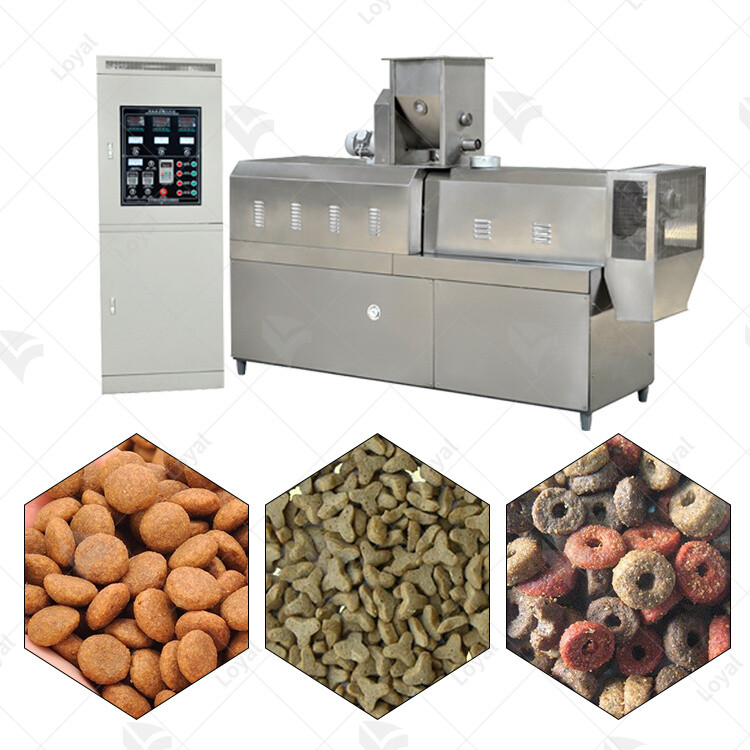
Dog Food EquipmentPerformance Features:
1. Adopts frequency converter speed regulation technology, making the equipment run more smoothly and save energy;
2. The screw is made of alloy steel material and special process, which is wear-resistant and has high pressure resistance; a forced lubrication system ensures a longer service life for the transmission parts of the equipment;
3. Visual fully automatic temperature control system for more intuitive temperature control and more accurate parameters;
4. The screw has a self-cleaning function, eliminating the need to disassemble the screw for cleaning when the machine is stopped.
5. Low energy consumption, high efficiency, and leak-proof, pollution-free food transport within a closed stainless steel channel, making it particularly advantageous for long-distance transport.
6. Small footprint, large drying area, small surface area, low heat dissipation, and high thermal efficiency.
7. Adjustable conveyor belt speed to regulate drying time within the oven.
8. Automatic temperature control, adjustable as needed.

Dog Food Equipment Feed Production
1. Comprehensive Nutrition: A diverse range of feed types should meet the needs for protein, fat, and carbohydrates, with appropriate supplementation of vitamins and minerals to satisfy the dog's nutritional requirements and prevent anorexia.
2. Digestibility: Dogs have a strong ability to digest and absorb protein and fat, but a poor ability to utilize crude fiber. Therefore, the content of various nutrients in the diet should be higher than the dog's nutritional needs.
3. Processing: Increase palatability and improve digestibility. Feed must be fresh, hygienic, and easily digestible, and mold and spoilage are strictly prohibited. Raw meat or offal should be washed thoroughly, chopped, and cooked. Then, mix in washed fresh vegetables and boil briefly to make a meat and vegetable broth. Mix this broth with rice porridge, and add a small amount of salt, fish bone meal, yeast, cod liver oil, and vitamins just before feeding.
Dog Food Equipment Feeding and Management: Dogs are carnivores, but their diet is varied. Dog food must be primarily animal-based, accounting for about 30%. Animal-based foods for dogs include beef, mutton, poultry, birds, rodents, as well as various fresh offal and fish. Plant-based foods mainly consist of various grains and vegetables. Grains include cornmeal, barley residue, soybean meal, sorghum flour, and bran. Grain feed should be mixed in the correct proportions. A sample formula is: meat 30%, dairy 5%, grains 40%, and vegetables 10%. Each dog should also be given 3 grams of yeast, 3 grams of bone meal, 2 grams of salt, and 1-2 drops of cod liver oil daily. Feeding amounts should be appropriate, twice a day. The morning feed should comprise 40% of the dog's diet, and the evening feed 60%. For an adult dog, the daily feed intake should be approximately 1500 grams.
During the rearing period, puppies can generally be weaned and separated from their litters at 45-50 days of age. In production, this can be adjusted based on the puppy's growth and development. Stronger puppies with independent living abilities should be separated earlier; weaker puppies should be separated later. After separation, puppies enter the rearing period. Because puppies grow rapidly during this stage, especially in the later stages, they require a large amount of nutrients. Therefore, in production, puppies should be fed well and adequately to ensure normal growth and development.
What are the typical configuration steps for a small-scale production line? This includes a crusher, mixer, extruder, dryer, and oil sprayer.
What are the typical configuration steps for a medium-sized production line? This includes crushing, mixing, extrusion, drying, cooling, oil spraying, and screening.
What are the typical configuration steps for a large-scale fully automated production line? This includes automatic batching, crushing and mixing, extrusion and drying, cooling and oil spraying, screening, and packaging.
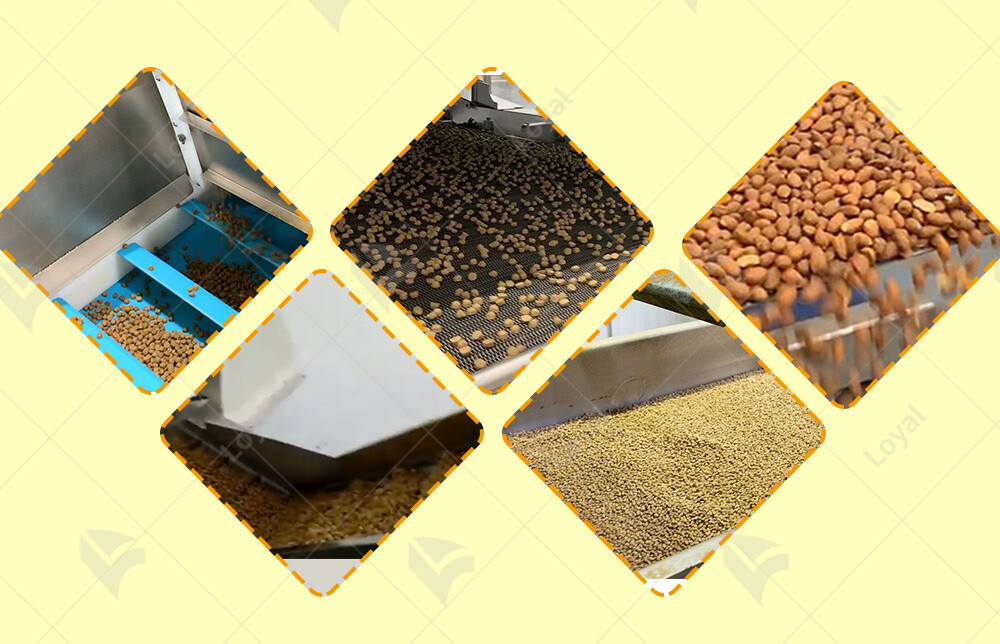
What are the process configuration steps for a 1-5 ton dog food production line?
How to configure a 1-5 ton large-scale pet food production line? The complete process flow includes an automatic batching section, a crushing and mixing section, an extrusion and drying section, a cooling and oil spraying section, and a packaging section.
1. Automatic batching section: Generally uses 4, 6, or 8 storage bins for different raw materials, employing automatic batching scales to accurately weigh the proportions of different raw materials. Saves labor and is highly efficient.
2. Crushing and mixing section: Generally uses a dual-rotor crusher, a twin-shaft paddle mixer, etc., employing a pulse dust collector, resulting in a dust-free crushing process.
3. Extrusion and drying section. Most utilize advanced twin-screw pet food extruders, equipped with energy-efficient dryers, resulting in excellent extrusion, gas-saving drying, and low cost.
4. Cooling and Oil Spraying Section: Employs a counter-flow cooler and a belt-type mixing and oil spraying system, ensuring uniform mixing and oil addition. This results in extremely low breakage.
5. Packaging Section: Currently available on the market are machines suitable for small and large packaging, including 1-5 catties, under 5 kg, 5-10 kg, and 10-25 kg sizes.

Reference
The following are five authoritative foreign literature websites in the field of Industrial food machinery:
1. Food Engineering Magazine
Website: https://www.foodengineeringmag.com/
2.Food Processing Magazine
Website: https://www.foodprocessing.com/
3.Journal of Food Engineering
Website:https://www.journals.elsevier.com/journal-of-food-engineering
4. Food Manufacturing Magazine
Website:https://www.foodmanufacturing.com/
5. International Journal of Food Science & Technology
Website:https://onlinelibrary.wiley.com/